Walls, Turtles and Barracuda: The Complete Diver's Guide to Sipadan, Mabul, Kapalai and Si Amil
A volcanic pinnacle rising from 600 metres of open ocean, a continental shelf rich in macro life, a sandbar famous for mandarin fish at dusk, and a remote island that draws devil rays from the deep — four entirely different dive environments within reach of the same Sabah basecamp.
Off the southeast coast of Sabah, on the island of Borneo, the underwater geography divides along a single geological boundary. Mabul and Kapalai sit on the shallow edge of the Borneo continental shelf — sandy, rubble-strewn reef environments in calm, sheltered water. Twenty minutes to the south, that shelf gives way to open ocean. Sipadan Island stands at this transition: a volcanic cone that has grown straight from a seafloor 600 metres below the surface, breaching as a sand cay fringed by living coral. Its reef flats begin at five metres. Its walls drop vertically from there — to 600 metres on the northern side, and beyond 2,000 metres in the south. The result is two entirely different kinds of diving within a single short boat ride, and a third at Si Amil an hour further southeast.
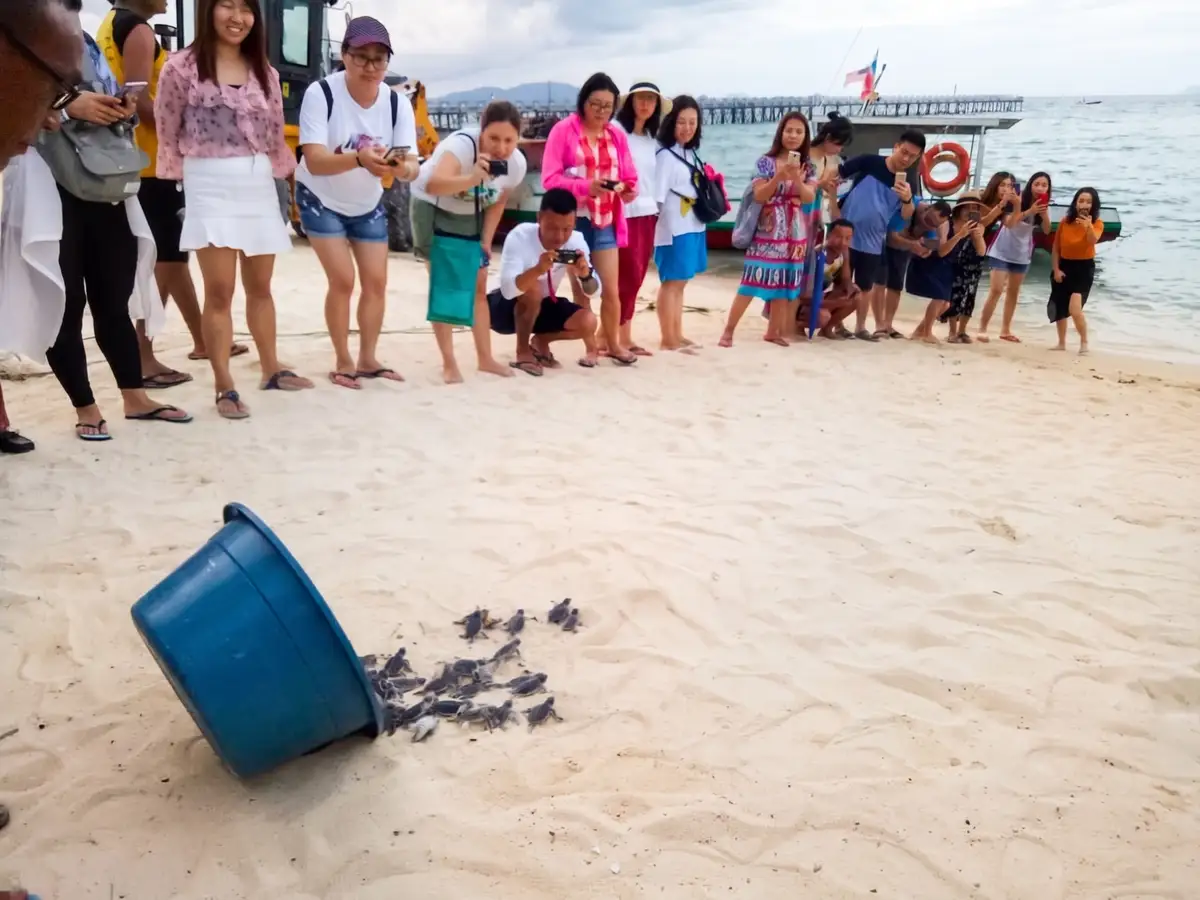
All four destinations lie within the Coral Triangle, the region spanning six nations that supports more than 75 per cent of the world's reef-building coral species. The Sipadan area alone holds more than 550 species of hard coral and 3,000 species of reef fish, and serves as a critical sanctuary for green and hawksbill sea turtles. Sipadan is routinely listed among the finest dive sites on earth. The continental shelf islands on either side of it offer a quality of diving that would justify the journey independently.
At a Glance
| Best time to visit | March to October |
| Diving season | Year-round; Sipadan closed throughout November |
| Water temperature | 26°C - 30°C |
| Visibility | 20-50m (oceanic sites); 10-25m wet season |
| Sipadan permits | 252 per day; Advanced Open Water minimum required |
| Getting there | Fly to Tawau (TWU); ~90 min overland to Semporna; 45 min boat |
Sipadan: The Oceanic Pinnacle
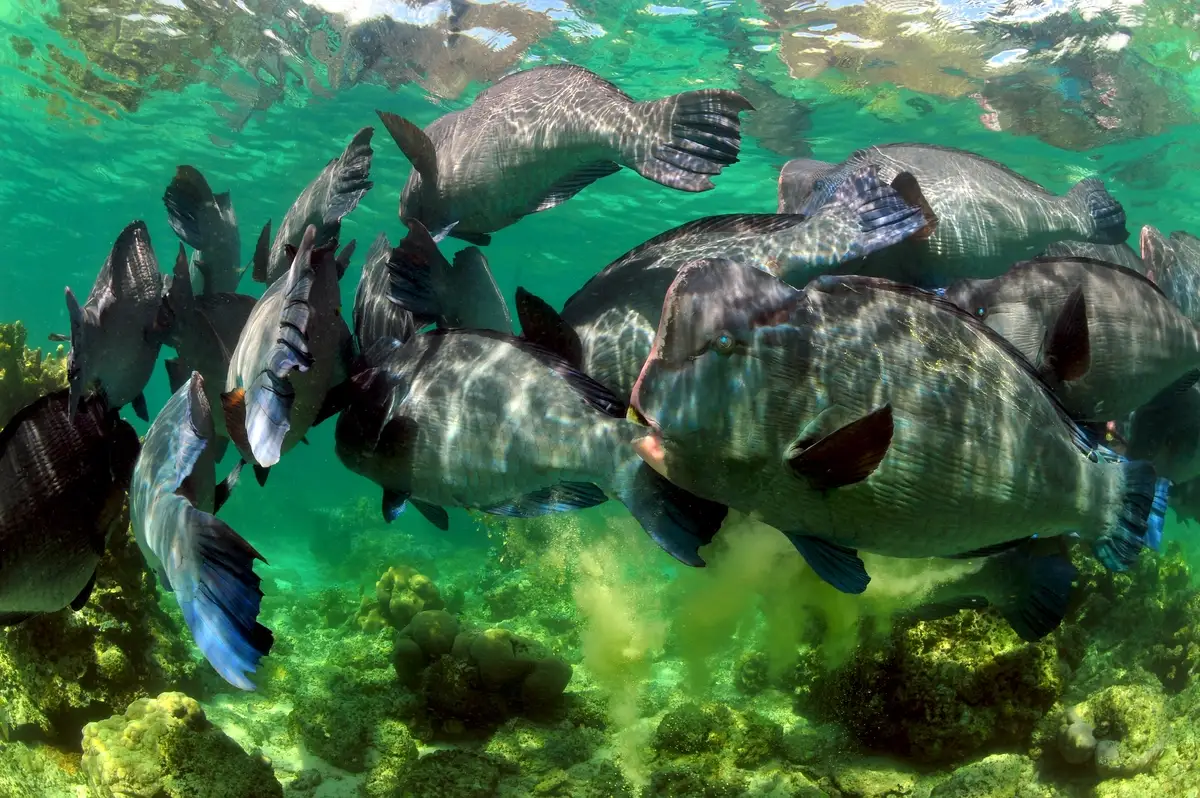
The walls here are not metaphor. At Barracuda Point, on the island's northern tip, the seafloor drops vertically from the reef flat and continues dropping, past any depth a recreational diver will reach, into open ocean. Circling above this abyss, chevron barracuda organise into slow, rotating columns — hundreds of fish forming a vortex in open water that is one of the most arresting sights in diving. Bumphead parrotfish move across the reef in herds, cropping coral with a sound audible underwater. Green and hawksbill turtles are present in numbers exceeding almost anywhere else on earth — resting on ledges, surfacing for air, moving unhurriedly across the reef flat as a constant background presence rather than a highlight sighting. Grey reef sharks and whitetip reef sharks work the walls at depth. On a productive day, scalloped hammerhead sharks and thresher sharks are encountered at South Point on the island's southeastern edge, where the wall transitions to a ledge at 20 metres before dropping again into open water.
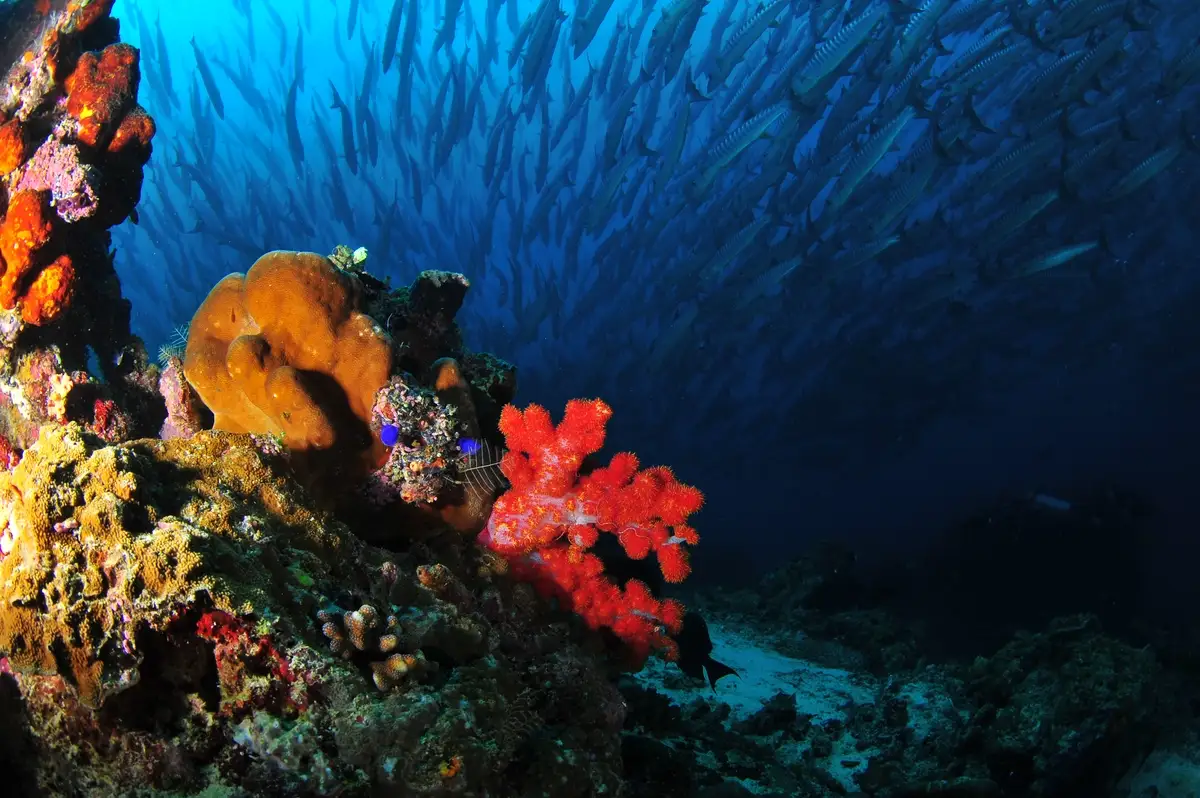
The topography extends beneath the island as well as down its walls. An extensive limestone cave system — Turtle Cavern and Turtle Tomb — holds turtle skeletons on the cave floor. Access to the cave interior requires technical diving qualifications; the cavern entrance and the outer wall accessible from the jetty can be dived on a standard permit. Hanging Gardens, on the western side, is a softer contrast — the wall here is draped in dense soft corals and suits divers who want to slow down and observe reef structure rather than chase open-water pelagics. Mid-Reef, on the eastern side at 15 to 20 metres, is coral-rich and shallower, with green turtles reliably present and Moorish idols moving through the sea fans. White-Tip Avenue rewards patient, unhurried divers with sustained close observation of whitetip reef sharks resting on the sand and along the reef ledges.
Barracuda Point in particular is known for unpredictable downdrafts and horizontal currents. Divers should discuss site conditions with their guide before descending.
Mabul: Macro Life on the Continental Shelf
The contrast with Sipadan is complete. Mabul's underwater environment is built on gently sloping reefs, sandy flats, and rubble substrate — an environment that, beside Sipadan's dramatic walls, appears unremarkable until a diver slows down and starts to look. The island sits on the Borneo continental shelf 15 to 20 minutes by boat from Sipadan, and its reefs hold an inventory of small, cryptic marine life that draws dedicated macro photographers from across the world.
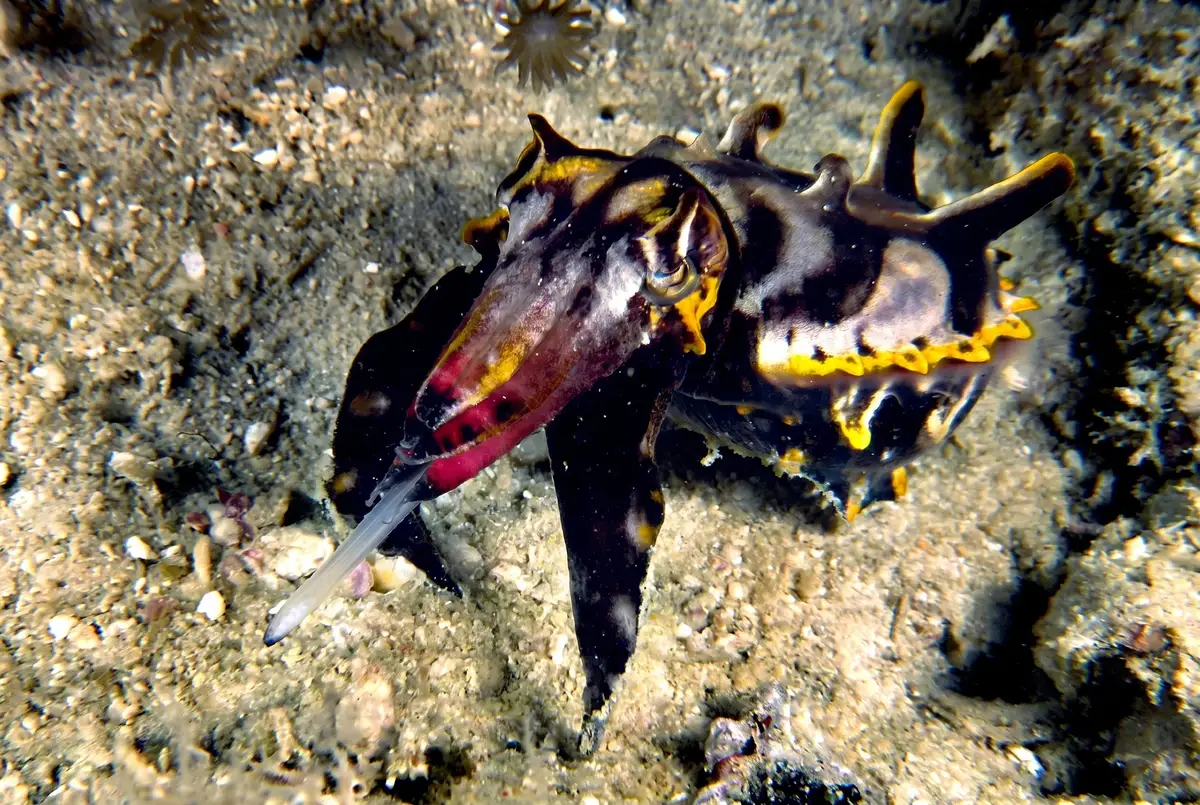
Flamboyant cuttlefish move across the substrate in pulsing patterns of purple, yellow, and white. Multiple frogfish species occupy the reef at various depths and in varied colour phases. Blue-ringed octopuses, mimic octopuses, and bobtail squid inhabit the sand and rubble. Ornate ghost pipefish hover near crinoids. Harlequin shrimp are found on dedicated searches. The approach that consistently produces more is a slow, methodical one. Froggy Lair holds concentrated frogfish and cuttlefish encounters. Crocodile Avenue is named for the crocodilefish that lie motionless and heavily camouflaged on the sandy bottom, with seahorses found alongside them. Eel Garden hosts dense colonies of garden and ribbon eels — juvenile black, adult male blue, adult female yellow — emerging from the substrate in large numbers. Paradise 2 holds mandarin fish within staghorn coral branches, an encounter that requires timing your arrival toward dusk. Lobster Wall, reaching 40 metres along a vertical drop, suits divers looking for a deeper profile and larger reef species.
The Seaventures Dive Rig is a decommissioned oil platform converted into a functioning hotel, and its underwater structure is unlike anything else in the region. The accumulated metal framework, descending to approximately 17 metres, is occupied by frogfish in yellow, red, and black alongside pygmy seahorses, ghost pipefish, nudibranchs, and giant moray eels. Substantial shelter from current allows extended, unhurried exploration.
Between dives, Mabul presents a cultural dimension unusual among the region's islands. The island is shared between dive resort infrastructure and two long-established communities: the Bajau Laut — traditional sea nomads whose cultural identity has been built entirely around the ocean — and the Suluk, with origins in the southern Philippines. The juxtaposition is visible from the resort jetties.
Kapalai: The Shallow Sanctuary
What appears on maps as an island is not one in any conventional sense. Kapalai is an eroded sandbar atop the Ligitan Reefs, submerged entirely at high tide. Two hundred years ago it supported vegetation; erosion has reduced it to a sand flat that now holds a single resort built on wooden stilts over the water. The diving occurs around the reef structure below — a combination of shallow sandy flats, coral rubble, and artificial frames placed deliberately to concentrate marine life.
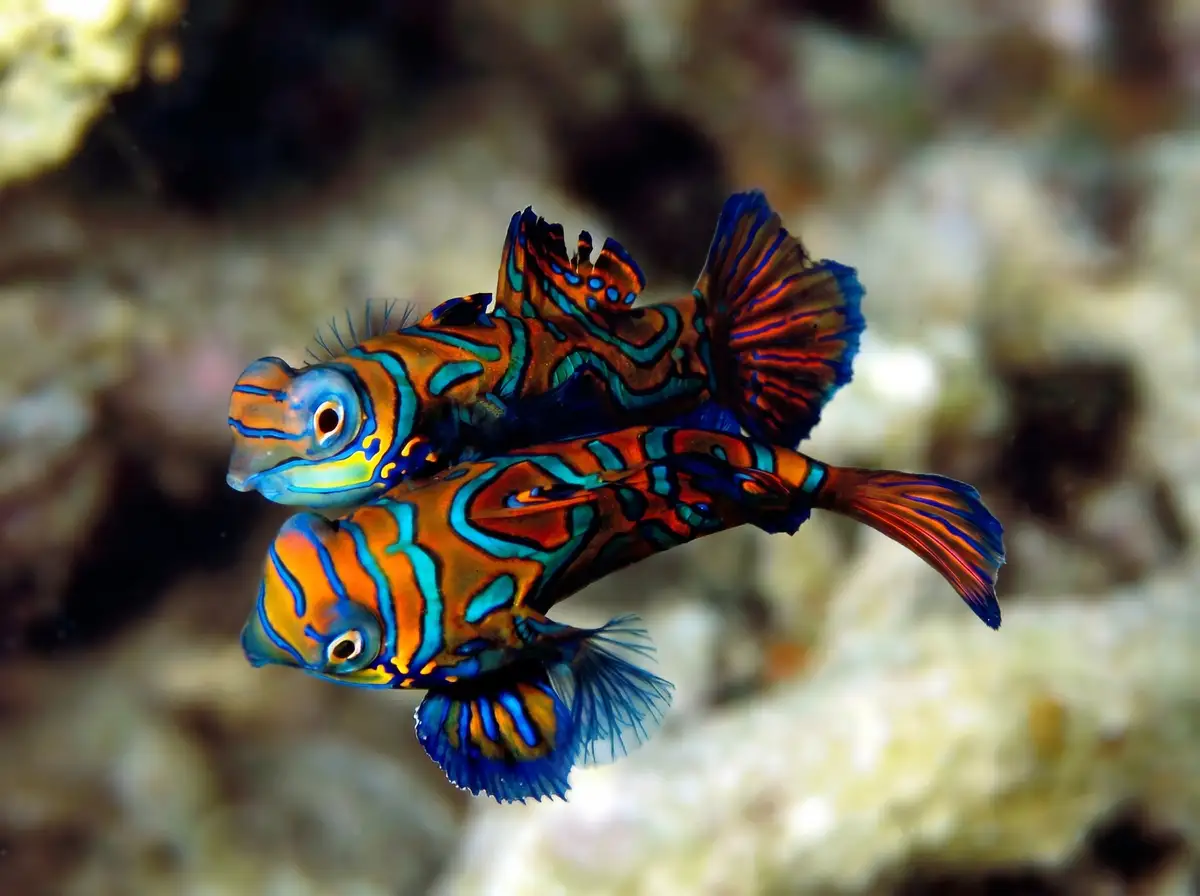
The defining encounter at Kapalai is the mandarin fish. These small, vividly coloured fish — no other fish in the ocean carries quite the same intensity of electric blue, orange, and green — shelter during daylight hours within coral rubble and beneath sea urchins at Mandarin Valley. After dusk, they emerge briefly for their mating display in the shallow reef: a behaviour timed to the fading light and over within minutes. It is one of the most consistently sought-after small-creature encounters in the macro diving world.
The broader site inventory covers varied characters within a compact area. The House Reef and jetty area holds five sunken fishing boats clustered at approximately 18 metres, each occupied by stonefish at the hull corners and nudibranchs, cleaner shrimps, and orangutan crabs inside. Flambo Reef targets flamboyant cuttlefish and blue-ringed octopuses. Mantis Ground is dedicated territory for the peacock mantis shrimp — a formidable predator growing to 30 centimetres with striking colouration and striking speed. Frontier Reef, less frequently visited and set slightly further from the resort, holds frogfish and leaf fish noted as species rarely encountered at the more trafficked sites. The exception to the generally calm, shallow character is Mid Reef, at 25 metres and subject to meaningful current on descent, which yields pygmy seahorses in coral branches for divers who manage the entry.
Conditions across Kapalai suit a wide range of experience levels, and the shallow profiles allow extended bottom times.
Si Amil: The Pelagic Day Trip
Si Amil sits 35 kilometres southeast of Semporna, approximately an hour by boat from Sipadan. Overnight stays on the island are not permitted — a Malaysian army base and a lighthouse built in 1952 are the only permanent structures — and this restriction has preserved it as one of the least disturbed sites in the region. The topside character is worth noting before the diving: dense interior forest, abandoned World War II Japanese structures, and old ship boilers jutting from the water beside the jetty give it a character entirely distinct from the resort islands.
The diving combines two appeals that rarely coexist at a single location. The deep-water channels — at 2nd Beach and East Point, where the Alice Channel drops several hundred metres — draw schooling devil rays, eagle rays, and great barracuda in open-water conditions that, on a productive day, rival Sipadan's pelagic encounters. The sandy bottoms and reef structures at 1st Beach hold rhinopia, Ambon scorpionfish, blue-ringed octopuses, pygmy seahorses, and sea dragons — a macro inventory that matches Mabul's most productive sites. 3rd Beach runs as a drift across bright sponge fields carried by the current. Meditation Wall, on the island's calmer side, rewards slower photography with exceptional nudibranch diversity. Bamboo sharks appear along the sloping reefs primarily at night.
For most itineraries, divers will secure one or two Sipadan permit days across a week. Si Amil is not a substitute for those days — it is a different kind of dive. Its value is that the non-permit days in any schedule remain genuinely exceptional rather than a gap to fill.
When to Visit
The dry season runs from March to October, with the calmest sea conditions and visibility of 20 to 50 metres at the oceanic sites. This is the most comfortable time to dive Sipadan, and the period when surface conditions for the longer boat transfer to Si Amil are most predictable.
The wet season, from December to February, brings choppier surface conditions and reduced visibility of 10 to 25 metres, driven by the northeast monsoon. The macro life on Mabul and Kapalai is unaffected by season, and the cooler, nutrient-rich water continues to sustain the marine biomass for which the region is known. A wet-season stay at the continental shelf sites is fully viable and offers no material reduction in dive quality.
Sipadan Island enforces a complete conservation closure throughout November, allowing the reef uninterrupted recovery time. Mabul, Kapalai, Si Amil, and all surrounding islands remain fully operational throughout the month.
Getting There
The gateway to the region is Tawau Airport (TWU) in Sabah, served by domestic connections from Kuala Lumpur, Kota Kinabalu, and other Malaysian hubs. From the airport, a 75 to 90-minute overland transfer reaches the port town of Semporna, followed by a 45-minute speedboat crossing to the island resorts. Most resorts arrange the full transfer as part of their packages.
Planning Your Trip
The Sipadan permit system is the central logistics consideration for any itinerary in this region. Sabah Parks enforces a daily quota of 252 permits, allocated directly to participating resorts and distributed across guests on a round-robin basis; longer-stay guests typically receive allocation priority. Permits are not sold independently — they are secured through a resort as part of a dive package.
From 1 May 2026, the permit system operates on a zone structure. Each permit covers three dives per day, with one dive assigned to each of three designated zones: Zone 1 (Barracuda Point), Zone 2 (South Point), and a third zone. Divers who include Turtle Cave in their day may use their remaining two dives freely across any sites of their choosing. This represents an increase from the previous allocation of two dives per permit per day.
To guarantee a permit, a minimum stay of three to four nights at a participating resort is generally required, and advance booking is essential. Each resort is allocated a fixed number of permits, and quantities vary — the resorts we work with in this area differ in permit allocation and in how they balance Sipadan days against the shelf-site programme, which is worth understanding before committing to dates.
One requirement applies without exception: all divers must hold a minimum Advanced Open Water certification to dive Sipadan. Divers arriving with an Open Water certification will not receive a Sipadan permit regardless of their booking. Open Water certified divers can access all other sites in the region — Mabul, Kapalai, and Si Amil — without restriction.
For divers looking to extend their Sabah itinerary, Lankayan Island to the north and the islands of Tun Sakaran Marine Park to the northwest are accessible from separate resort bases.