Edge of the Bird's Head: The Complete Diver's Guide to Triton Bay
A remote bay on the southern coast of West Papua where river nutrients feed one of the most productive reef systems in the Coral Triangle, an endemic walking shark prowls the soft coral gardens, and whale sharks gather reliably around traditional fishing platforms.
Triton Bay lies on the southern coast of West Papua, within the Kaimana Regency, at the southern edge of the Bird's Head Seascape — the same extended reef system that places this corner of the Coral Triangle among the most biologically dense ocean environments on earth. The bay is fed by multiple mainland rivers whose nutrient-rich freshwater enters the marine environment in a constant exchange that defines everything about the diving here. Visibility runs to roughly 5 to 10 metres, limited by the same river input that fuels an extraordinary proliferation of soft corals, leather corals, sea fans, and fringing reef life. Surveying teams have recorded 330 species of fish on a single dive. The broader Bird's Head Seascape holds more than 75 per cent of the world's known hard coral species and over 1,500 species of reef fish.
Two encounters distinguish Triton Bay from every other destination in this part of Indonesia. Henry's Epaulette Shark — a walking shark endemic to these waters — moves across the reef on its pectoral and pelvic fins rather than swimming. The Indonesian Wobbegong, a flattened, carpet-patterned ambush predator, rests motionless on the reef substrate in a way that makes it indistinguishable from the bottom until it is almost within touching distance. And in Triton Bay and the neighbouring Bitsyari Bay, whale sharks gather around traditional fishing platforms in encounters that are predictable in a way that whale shark diving almost never is elsewhere.
At a Glance
| Diving season | Late September to early June |
| Off-season | June to September — diving not viable |
| Water temperature | 28°C - 30°C (sudden upwellings to ~22°C possible) |
| Visibility | 5-10m (green water from river nutrients) |
| Getting there | Fly to Kaimana (KNG); ~2 hrs speedboat into the bay |
The Iris Strait
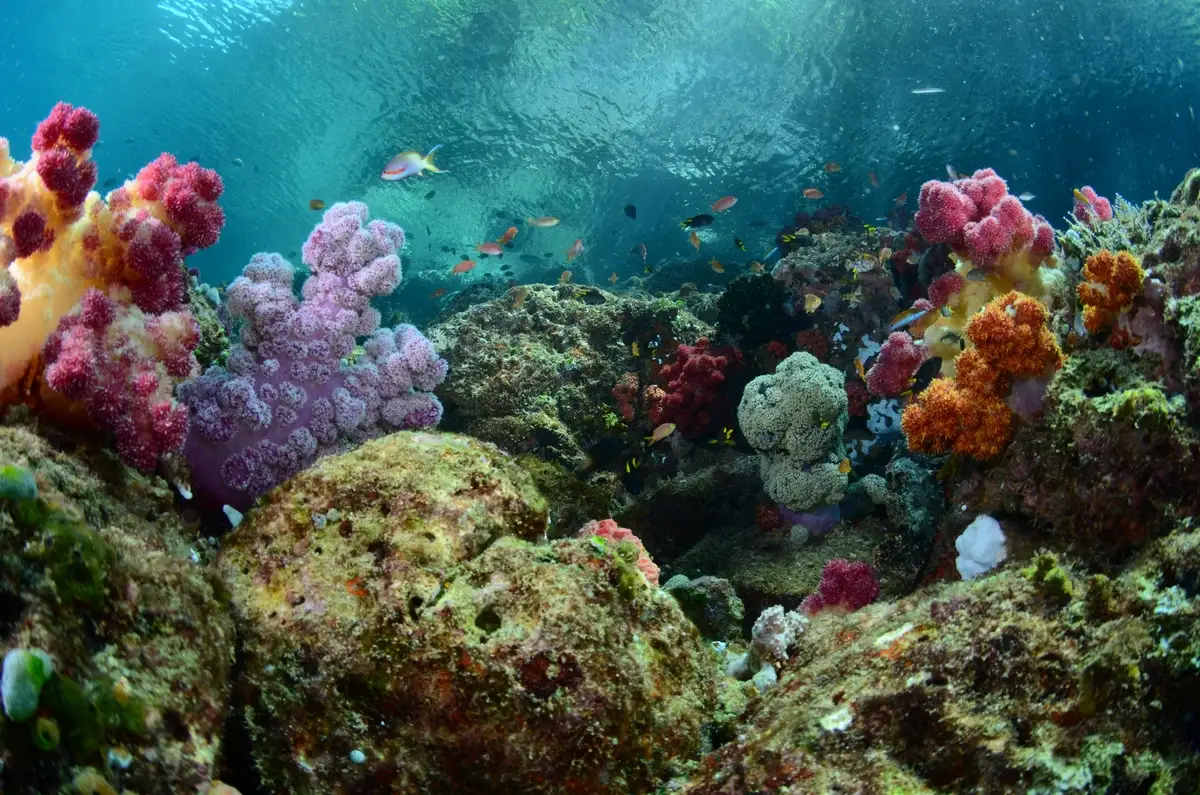
The Iris Strait runs between Aiduma Island and the West Papua mainland, channelling large volumes of ocean water and nutrient-rich currents that sustain the bay's reef density. The bathymetry is more varied than the sheltered surface appearance suggests: shallow coral gardens at 3 to 10 metres give way to shelving reef slopes descending to around 20 metres at sites like Tangga, and deeper rubble habitats near the bay entrance reach 42 to 60 metres. Jungle-covered islets and eroded limestone walls frame the surface throughout — at Froggies, the topography becomes a karst fjord of eroded rock that extends underwater into the reef structure below. Over 30 named sites exist within and around the strait.
The reef character here is defined by purple-grey leather corals in irregular, sculptural forms, spiralling sea whips, and sea fans in purple, pink, and yellow running across the slopes. Tangga — known locally as Pygmy Point — is a macro site on the Aiduma Island side of the strait where the shelving steps hold pygmy seahorses, horned shrimp, and juvenile pinnate batfish in the density that only this level of nutrient input produces. The endemic flasher wrasse performs rapid colour-shifting courtship displays in the shallower sections of the same site. Engine Point is the soft coral site: the volume and colour of the formations here are a direct product of the current running through the channel. Bo's Rainbow draws divers for the large, sociable aggregations of spadefish that gather in the open water around the reef.
Henry's Epaulette Shark inhabits the shallower end of the strait, where the 3 to 10-metre coral gardens provide the reef structure it uses to move between resting spots. The Indonesian Wobbegong occupies the ledges and rubble of the same zone, holding position in camouflage until something approaches too close.
Saruenus Island
Saruenus Island sits in the Iris Strait a few minutes by boat from Aiduma Island, and its two sides offer diving of entirely different character. The sheltered eastern side descends through a forest of black coral bushes that glow green-white in torchlight — extraordinary visual density at around 10 metres, with rivers of fusiliers, bannerfish, and cardinalfish moving through the branches alongside ruby-red soft corals. Little Komodo is the standout site on this side, named for the scale and richness of the black coral ecosystem and the massive fish aggregations that populate it.
The western face of the island is open to the full force of the current. Pintu Arus — the “door to the current” — is where the water accelerates through the gap between islands and carries divers along the reef face past soft coral formations in conditions that shift depending on the state of the tide.
Dramai Island
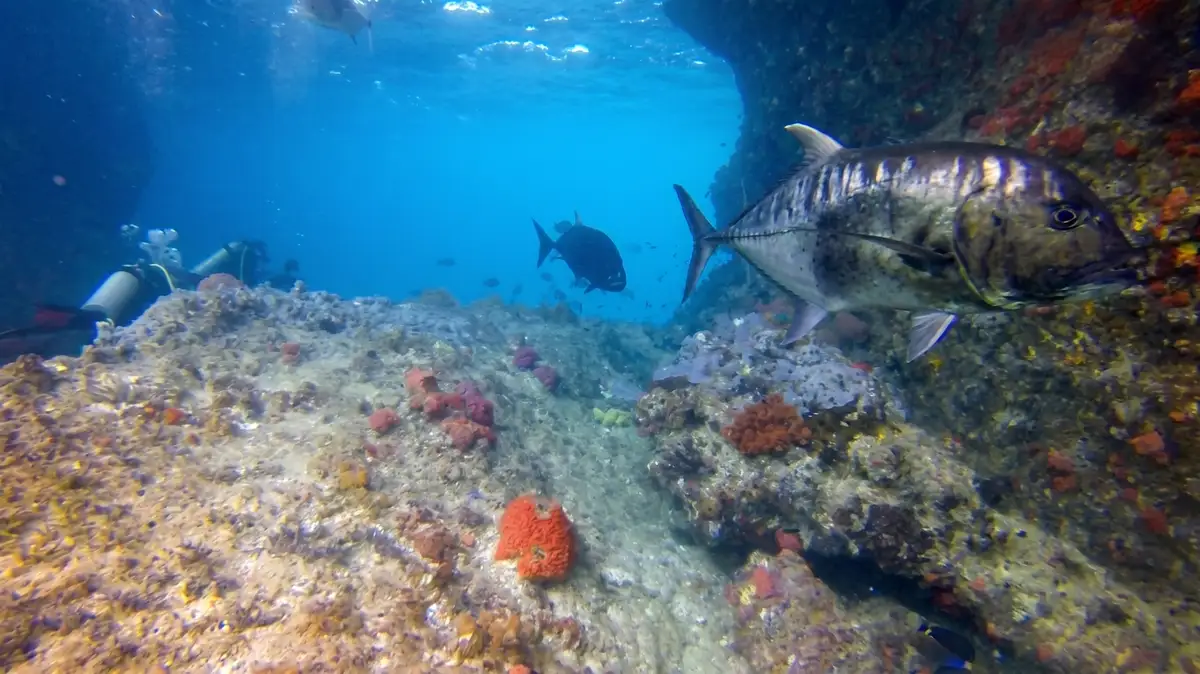
Dramai Island sits at the far southern end of the Iris Strait where the channel meets the open ocean. The signature site, Batu Dramai, centres on a submerged rock with terraced ledges, completely exposed to oceanic conditions and regularly swept by swift currents. The marine life here organises around predation: large schools of surgeonfish and rabbitfish, bumphead parrotfish, giant trevallies and bluefin jacks hunting along the perimeter, and pinjalo snappers in the open water above. Wobbegong sharks rest under the rocky ledges throughout. It is the most high-energy dive in the bay and the one most variable with current conditions.
Whale Sharks at the Bagans
In Triton Bay and the neighbouring Bitsyari Bay, whale sharks gather around traditional Indonesian lift-net fishing platforms called bagans in an arrangement that has developed over many years of coexistence. The platforms are operated by local fishermen who use powerful lights at night to attract baitfish and anchovies to the surface. The whale sharks — which can reach 12 metres in length — have learned to associate the bagans with feeding and return consistently to collect the scraps that spill from the nets. The result is a shallow-water encounter beneath the platform structure where divers and snorkellers enter the water and observe the animals feeding at close range without any searching involved.
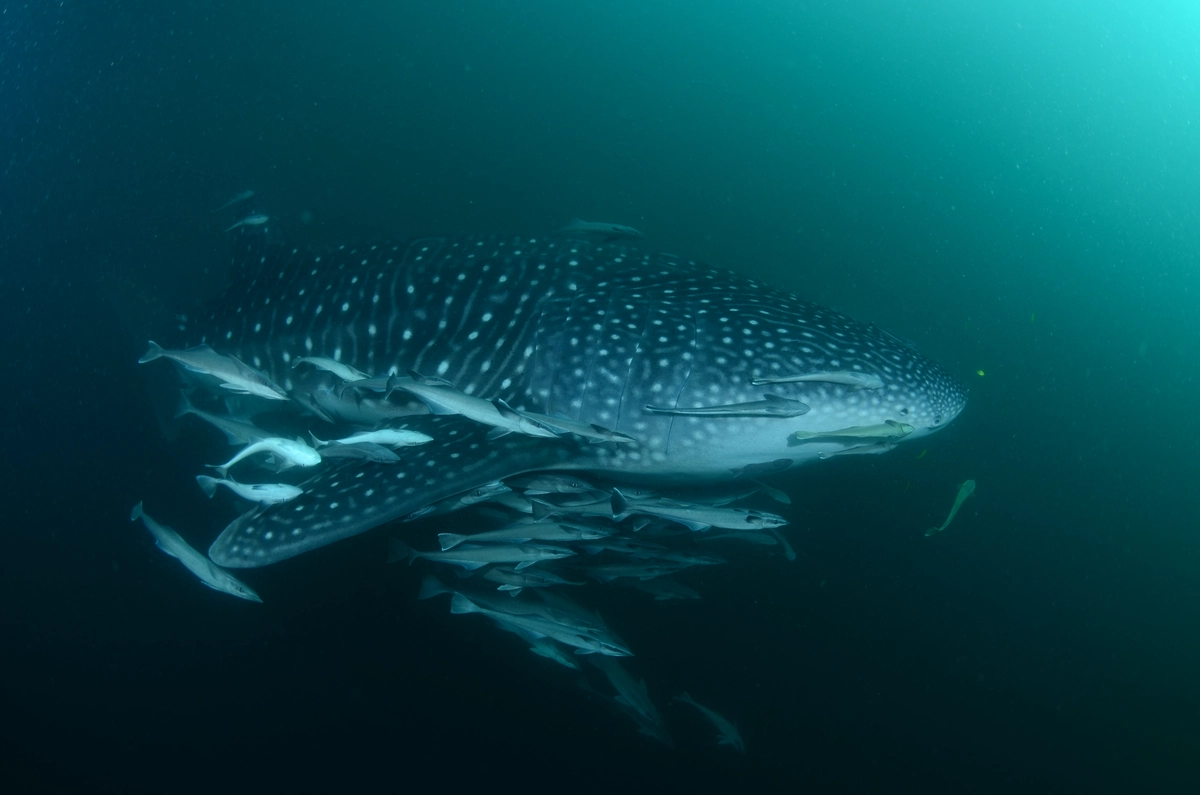
This reliability is unusual. Whale shark encounters at most destinations depend on season, current alignment, and a significant element of luck. At the Triton Bay bagans, the relationship between the sharks and the local fishing community has produced something close to a predictable wildlife encounter in a species that rarely allows one. The bay holds an official designation as an Important Shark and Ray Area, reflecting the significance of the population concentrated here.
This relationship between the sharks and local fishermen also illustrates something broader about the Kaimana Regency: traditional livelihoods and healthy marine ecosystems here have evolved in parallel rather than in conflict.
The Kaimana Marine Protected Area
The biological richness across the Iris Strait, Saruenus, and Dramai is not incidental. It is the direct outcome of the Kaimana Marine Protected Area, established in the late 2000s through a partnership between local communities, regional government, and international marine research organisations. The MPA operates through strictly enforced no-take zones and a community stewardship model in which local villages participate actively in monitoring and enforcement rather than as passive subjects of regulation. Fish populations within the protected zones have recovered measurably since establishment. The endemic species found here — Henry's Epaulette Shark, the Spotted-belly Catshark, and the flasher wrasse — are documented evidence of an ecosystem under functioning, long-term protection.
Topside
The karst walls near Namatota Island carry ancient cliff paintings in blood-red pigment, evidence of human presence in this part of West Papua extending back thousands of years. These are not a separate excursion — they are visible from the boat during transit between dive sites, a detail of the landscape that makes the passage between dives an observation in itself.
When to Visit
The prime diving window runs from late September to early June. During this period, conditions in the Iris Strait are at their most accessible and the full range of sites is operational. The southeast monsoon through this window brings upwellings that spike primary productivity and feed the soft coral growth for which the bay is known — conditions that make the early portion of the season particularly rich.
The eastern monsoon between June and September makes diving unviable. Rough surface conditions and sustained winds stop boat operations entirely, and there is no period of marginal workability to plan around. Unlike most destinations in the region, Triton Bay has a hard seasonal closure, and trip planning must account for it from the outset.
Water temperature runs between 28°C and 30°C through most of the diving season. Sudden cold upwellings are a characteristic of the bay — thermoclines can drop temperatures to around 22°C within a single dive, sometimes without advance indication at the surface.
Getting There
The gateway is Kaimana's Utarom Airport (KNG) on the southern coast of West Papua, reached by domestic flights from Jakarta, Bali, or Sorong. For divers already travelling through the Bird's Head region — via Raja Ampat or Sorong — the Sorong connection is the most direct routing into Kaimana. From the airport, a speedboat transfer of approximately two hours reaches the bay.
Planning Your Trip
Triton Bay is one of the most remote destinations in this collection. Land-based infrastructure is extremely limited — there is one dedicated dive resort in the area — and the logistics of reaching it require planning from the outset. The seasonal window is the single most critical variable: trips must fall within the late-September-to-early-June period, and advance booking is essential for the prime months. The green water character — 5 to 10-metre visibility driven by river nutrients — is part of the experience rather than a limitation. It is the same condition that produces the soft coral density, the extraordinary reef productivity, and the biological inventory that makes Triton Bay unlike any other destination in Indonesia — the resort we work with here handles transfers from Kaimana and is the only practical route to advance booking within the seasonal window.